


Payment processing is the technology and financial infrastructure that helps businesses accept electronic payments, authorize transactions, route payment data, clear transactions, and settle funds.
A customer might enter card details, tap a contactless card, scan a QR code, or choose a digital wallet. The transaction then moves through the systems required by that payment method.
The exact payment flow depends on the payment method, transaction type, provider, and market.
Card payments, ACH transfers, digital wallets, and buy now, pay later (BNPL) transactions don’t follow the same path because each payment method uses different participants, rules, networks, and processing infrastructure.
This guide explains what payment processing is, how it works, who handles each stage, what it costs, how businesses protect payments, and what common payment problems look like.
What Is Payment Processing?
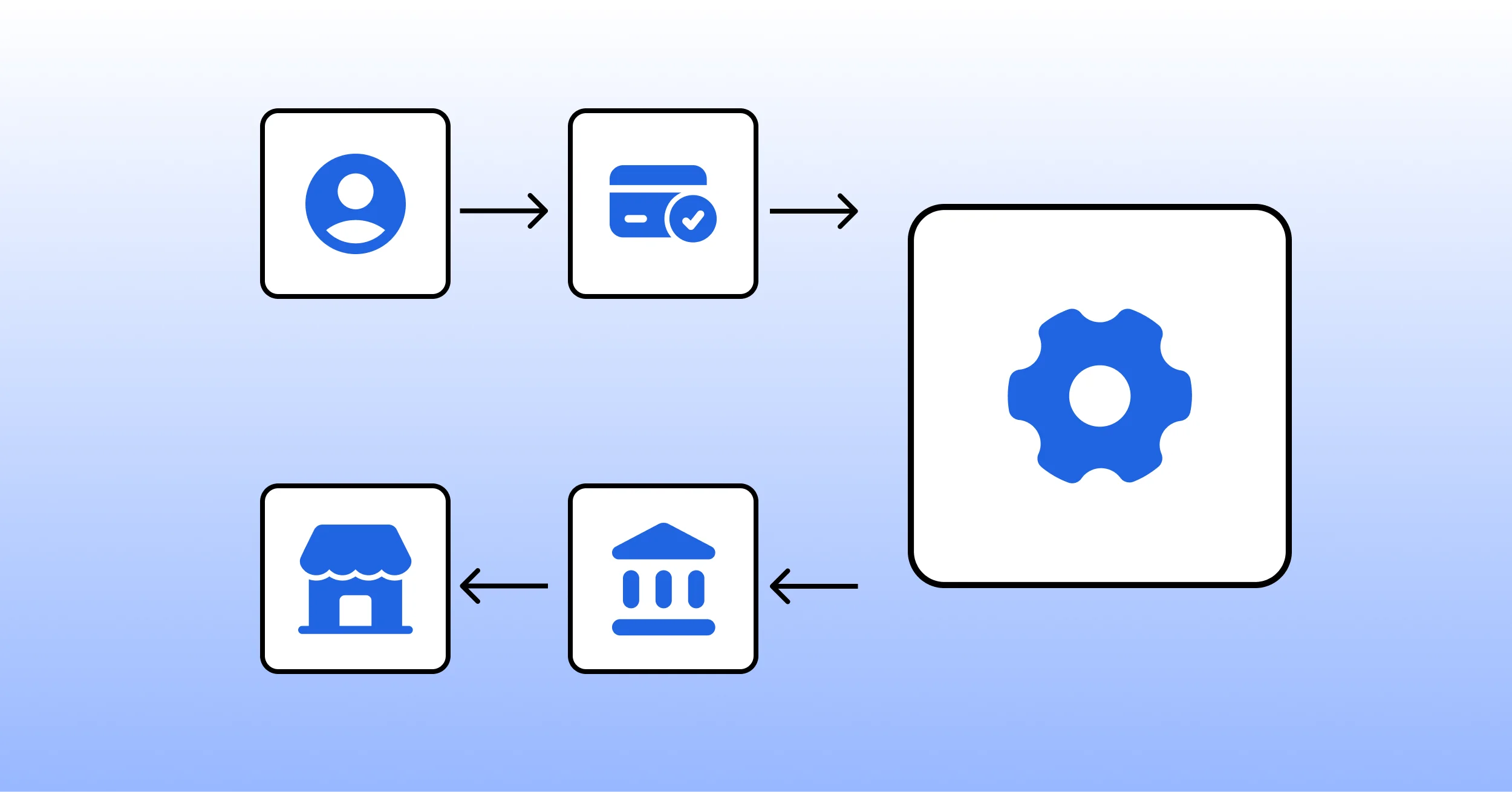
Payment processing is the combination of technology, financial institutions, payment networks, and payment services that helps businesses accept and complete electronic payments.
When a customer pays with a credit card, debit card, digital wallet, ACH transfer, or another supported payment method, multiple systems can work together to:
- Collect or receive payment information
- Authenticate the payer or validate transaction details when required
- Request authorization when the payment method requires it
- Route transaction data
- Approve or decline the payment
- Capture an authorized transaction
- Clear transaction information
- Settle financial obligations between participating institutions
- Report transaction activity
- Reconcile transactions, fees, refunds, disputes, and payouts
A payment processor does more than simply move money from a customer’s account to a merchant’s account. It helps process transaction messages and coordinate communication between participants in the payment flow.
And the exact architecture depends on the payment method and provider. Modern payment platforms can combine functions that businesses once handled through separate gateways, processors, acquirers, and other payment providers.
Payment Processing vs. a Payment Transaction
These terms sound similar, but they describe different things.
Payment processing refers to the broader system and workflow used to handle electronic payments.
A payment transaction refers to one specific payment moving through that system.
For example, when a customer spends $100 on your website, that $100 payment represents one transaction. The technology and financial infrastructure that handle that transaction form part of the payment-processing system.
How Does Payment Processing Work?
There isn’t one universal payment-processing path.
A card transaction can involve a gateway, processor, acquirer, card network, and issuer, while an ACH payment follows the ACH Network and its own operating rules. Digital wallets and BNPL services can introduce different providers, authentication steps, and settlement arrangements.
So the clearest way to understand the process is to start with a typical card payment.
1. The Customer Starts a Payment
The customer chooses a product or service and begins checkout.
They might:
- Enter a credit or debit card
- Tap a contactless card
- Use Apple Pay, Google Pay, or another digital wallet
- Select ACH or another supported bank payment method
- Use a buy now, pay later service
The checkout collects the information required for the selected payment method and sends it into the appropriate payment flow.
2. The Payment Gateway Transmits Payment Data
For many online card payments, a payment gateway securely transmits payment data from the checkout to the payment-processing infrastructure.
The gateway provides a connection between the customer-facing payment experience and the systems that handle the transaction.
The architecture varies by provider.
Some businesses use a separate gateway, while modern payment providers can combine gateway and processing functions within one service.
3. The Processor and Acquiring Side Route the Transaction
The payment processor helps handle transaction processing and communication between participants.
For card payments, the merchant’s acquiring side and processor route the authorization request through the card network to the issuer. Depending on the provider, the processor and acquirer may operate as separate entities or as functions offered through the same platform.
The acquirer, or acquiring bank, operates on the merchant side of the card transaction.
But the exact division of responsibilities varies. A merchant may work with separate providers, or one payment provider may combine several functions.
4. The Card Network Routes the Authorization
The card network connects the acquiring and issuing sides of a card transaction and routes authorization messages between them.
Common card networks include:
- Visa
- Mastercard
- American Express
- Discover
- UnionPay
The network routes the authorization request to the appropriate issuer and supports later clearing and settlement processes.
The network doesn’t decide whether the customer has enough available credit or funds. The issuer makes the authorization decision.
5. The Issuer Approves or Declines the Payment
The issuer is the financial institution that provides the customer’s card or payment account and makes the authorization decision for the transaction.
It can evaluate information such as:
- Account status
- Available credit or funds
- Transaction amount
- Card status
- Authentication results
- Fraud and risk indicators
- Applicable account restrictions
The issuer then returns an approval or decline response.
6. The Authorization Response Returns
The approval or decline travels back through the payment infrastructure to the checkout.
If the issuer approves the authorization request, the checkout can show that the payment was approved.
If the issuer declines it, the checkout can ask the customer to use another payment method or resolve the underlying problem.
An approval doesn’t mean the merchant has already received a payout.
Authorization determines whether the transaction can proceed. Capture, clearing, settlement, and merchant payout can happen later.
7. The Merchant Captures the Payment
Some card transactions combine authorization and capture almost immediately.
Others use separate authorization and capture steps.
For example, a merchant might authorize a payment when a customer places an order and capture it later after confirming inventory or completing another fulfillment step.
Capture tells the payment system to complete an authorized card transaction so it can proceed to clearing and settlement.
Capture doesn’t necessarily mean the merchant receives the money immediately.
8. Clearing Processes the Transaction
Clearing involves exchanging and processing transaction information between participating institutions so the parties can determine the amounts owed for completed transactions.
For card payments, the relevant participants process transaction records and calculate the financial obligations associated with those transactions.
9. Settlement Finalizes the Financial Obligations
Settlement handles the movement of funds between the relevant financial institutions after the transaction information has been cleared.
For a card transaction, settlement can move funds from the issuing side toward the acquiring side.
The merchant then receives a payout according to the payment provider’s payout schedule.
Settlement between financial institutions and the merchant’s payout aren’t necessarily the same event. A payment provider can receive or settle funds before it sends the merchant’s available balance to the merchant’s bank account.
10. The Merchant Reconciles the Payment
Payment processing doesn’t end when the transaction settles.
The business still needs to match:
Orders → Transactions → Fees → Refunds → Disputes → Payouts
This process is called payment reconciliation.
Reconciliation helps businesses verify that their ecommerce, accounting, or order-management records match the transactions and payouts reported by the payment provider.
Who Is Involved in Payment Processing?
A payment transaction can involve several participants and systems.
Not every payment includes every participant. The exact combination depends on the payment method, provider, market, and payment architecture.
Common participants include:
- Customer or payer: The person or organization initiating the payment.
- Merchant: The business accepting the payment.
- Payment method: The method the customer chooses, such as a card, ACH, digital wallet, or BNPL service.
- Checkout or POS system: The interface that collects payment information or initiates the transaction.
- Payment gateway: A technology service that securely transmits payment information between a checkout or payment interface and payment-processing infrastructure.
- Payment processor: A service that processes payment transaction messages and facilitates communication between the merchant’s acquiring side, payment networks, and other participants.
- Payment service provider (PSP): A provider that can combine services such as payment acceptance, processing, fraud prevention, reporting, and payment integrations through one platform.
- Payment facilitator: A provider model that enables sponsored merchants to accept card payments under the facilitator’s acquiring relationship instead of requiring each merchant to establish a separate direct acquiring relationship.
- Acquirer: The financial institution that operates on the merchant side of a card transaction.
- Card network: The network that routes card transactions and supports network rules, clearing, and settlement.
- Issuer: The financial institution that provides the customer’s card or payment account.
- Merchant account: An account structure that allows a business to accept card payments through an acquiring relationship.
Modern providers can combine several of these functions, so merchants shouldn’t assume that every transaction involves a different company for every role.
What Are the Main Types of Payment Processing?
Payment processing can vary by payment channel, payment method, and transaction type.
A customer paying with a chip card at a store doesn’t follow the same path as someone paying an online invoice with ACH.
In-Person Payment Processing
A customer pays at a physical location using a point-of-sale (POS) terminal or another supported payment device.
Common methods include:
- Chip cards
- Contactless cards
- Mobile wallets
- QR-code payments
Card-present transactions can use information captured directly by a physical payment terminal.
EMV chip technology generates transaction-specific data during supported chip-card transactions, helping reduce certain types of counterfeit-card fraud.
Online Payment Processing
Online payment processing handles card-not-present (CNP) and other digital payments through:
- Ecommerce stores
- WordPress payment forms
- Checkout pages
- Invoices
- Membership websites
- Subscription services
- Payment links
The customer doesn’t physically present the card to a merchant-controlled payment terminal, so the transaction typically falls into the card-not-present category.
That changes the risk profile and can require additional authentication or fraud controls.
Mobile Payment Processing
Mobile payments can involve:
- Mobile wallets
- In-app payments
- Mobile browser checkout
- QR codes
- Payment links
A smartphone can act as the checkout device, authentication device, or payment instrument, depending on the payment method and transaction flow.
ACH and Bank Payment Processing
ACH payments use the Automated Clearing House Network rather than card networks.
The ACH Network processes electronic credits and debits, including Direct Deposits and Direct Payments for consumers, businesses, and government entities.
ACH follows its own participants, operating rules, processing model, and settlement schedules.
Nacha estimates that 80% of ACH payments settle in one banking day or less, although individual transaction timing can vary by payment type and processing conditions.
Digital Wallet Processing
Digital wallets give customers a way to authorize payments using stored payment credentials, device-based authentication, and, where supported, tokenized payment credentials.
Examples include:
- Apple Pay
- Google Pay
- PayPal
- Cash App
The wallet provides the customer-facing payment experience, while the underlying transaction can still rely on card, bank, or other payment infrastructure.
Buy Now, Pay Later Processing
Buy now, pay later services let customers split or defer payment according to the provider’s terms.
The BNPL provider manages the customer’s repayment arrangement, while the merchant receives payment according to the provider’s merchant terms and settlement schedule.
The merchant therefore doesn’t necessarily follow the same payment lifecycle as a direct card transaction.
How Much Does Payment Processing Cost?
Payment processing costs vary by provider, payment method, country, transaction type, and pricing model.
Some providers charge a percentage of each transaction. Others combine a percentage with a fixed transaction fee, while some pricing models pass through underlying card costs and add a separate provider markup.
Common payment-processing costs include:
- Percentage-based processing fees: A percentage of the transaction amount.
- Fixed transaction fees: A fixed amount charged per transaction.
- Interchange: A card-related fee within the card payment ecosystem that generally goes to the issuing side.
- Card network fees: Fees associated with using a card network.
- Gateway fees: Charges that may apply when a separate payment gateway is used.
- Chargeback fees: Fees that may apply when a customer disputes a card transaction.
- International or cross-border fees: Additional charges that may apply to international transactions.
- Currency conversion fees: Charges that may apply when a transaction requires currency conversion.
- Monthly or account fees: Some providers charge recurring platform or account fees.
- Payout fees: Some providers may charge fees for specific payout methods or faster access to funds.
Common Payment Processing Pricing Models
Payment processors and payment service providers can use different pricing models.
The exact structure depends on the provider and payment method.
Flat-rate pricing charges a fixed percentage and/or fixed fee for each transaction.
Interchange-plus pricing separates underlying interchange and network costs from the provider’s markup.
Tiered pricing places transactions into pricing categories with different rates.
Subscription or membership pricing can combine a recurring platform fee with separate transaction charges.
When comparing providers, don’t look only at the headline transaction rate. Check the full fee structure, payout terms, chargeback costs, international fees, currency conversion charges, and any recurring account fees.
How Secure Is Payment Processing?
Payment processing can use multiple security controls to protect payment account data, authenticate transactions, and detect potential fraud.
The exact controls vary by payment method, provider, transaction type, and market.
Encryption
Encryption helps protect sensitive payment information while it moves between systems by making the data unreadable to unauthorized parties.
Tokenization
Tokenization replaces sensitive payment credentials with a token that systems can use instead of repeatedly exposing the underlying payment data.
Payment providers can use tokenization to reduce exposure to sensitive payment credentials.
PCI DSS
The Payment Card Industry Data Security Standard (PCI DSS) establishes baseline technical and operational requirements for protecting payment account data.
PCI SSC currently lists PCI DSS v4.0.1 in its document library.
PCI DSS applies to entities that store, process, or transmit cardholder data or sensitive authentication data, as well as entities that can affect the security of the cardholder data environment.
Outsourcing payment processing can reduce a merchant’s direct handling of card data, but it doesn’t automatically remove the merchant’s PCI DSS responsibilities.
EMV and Chip Cards
EMV chip technology generates transaction-specific data during supported chip-card transactions, helping reduce certain types of counterfeit-card fraud.
It doesn’t eliminate every form of payment fraud.
3D Secure
3D Secure adds an authentication layer to supported online card transactions and can require the customer to complete an additional verification step.
The customer may need to complete authentication when the transaction, issuer, or payment system requires it.
Authentication and authorization serve different purposes. Authentication helps verify the customer, while authorization determines whether the issuer approves the transaction.
Fraud Detection
Payment providers and other participants can analyze transaction patterns, device information, account signals, and other risk indicators to identify potentially fraudulent activity.
They can use those signals to approve transactions, decline suspicious activity, or request additional authentication when their systems support those actions.
Authentication
Authentication helps verify that the person initiating a transaction is authorized to use the selected payment method.
Depending on the payment method, authentication can involve a password, one-time code, biometric check, 3D Secure challenge, device verification, or another control.
Common Payment Processing Problems
Payments don’t always fail for the same reason.
Some failures happen during authorization. Others happen during integration, capture, settlement, or reconciliation.
1. Payment Declined
An issuer or payment provider can decline a transaction because of insufficient funds, account restrictions, fraud controls, authentication issues, or other conditions.
2. Payment Gateway Error
A gateway or checkout integration error can prevent transaction information from reaching the processing infrastructure.
A malformed API request, invalid configuration, expired credential, or frontend error can trigger this type of problem.
3. Processor Connection Failure
An API connection failure, expired authorization credential, configuration problem, or service outage can interrupt payment processing.
The merchant may see an error even though the customer started checkout correctly.
4. Payment Authorized but Not Captured
A payment can receive authorization without immediate capture when the merchant uses a separate authorization-and-capture workflow.
The merchant must capture the payment within the authorization validity period defined by the payment network, issuer, and payment provider.
If the merchant misses that window, the authorization can expire and the merchant may need to request a new authorization.
5. Delayed Settlement or Payout
Settlement and merchant payout can follow different timelines.
Timing can depend on the payment method, provider, country, account, transaction type, weekends, holidays, risk reviews, and other factors.
A successful authorization also doesn’t guarantee immediate access to the funds.
6. Duplicate Payment
A customer can sometimes submit a transaction more than once, especially when the checkout doesn’t clearly communicate the payment status.
Payment integrations can use idempotency keys, transaction-status checks, and appropriate retry logic to reduce the risk of duplicate processing.
7. Failed Recurring Payment
A recurring payment can fail because of an expired card, insufficient funds, account restrictions, authentication requirements, or another payment-method issue.
Subscription businesses should monitor failed recurring payments and provide customers with a clear way to update their payment information when needed.
8. Chargeback or Payment Dispute
A cardholder can dispute a card transaction through the issuing bank or card issuer.
The merchant then needs to follow the payment provider’s dispute process and provide the requested evidence within the applicable deadline.
9. Payment Missing From Reconciliation
A transaction can appear in the payment provider’s records but fail to match the merchant’s internal records because of timing differences, refunds, fees, disputes, settlement adjustments, or reporting delays.
10. Payment Authentication Failure
A transaction can fail when the customer doesn’t complete a required authentication step.
For example, an online card payment can fail when a customer doesn’t complete a required 3D Secure challenge.
11. Refund Delayed or Missing
A refund can take time to appear in the customer’s account because the provider, payment network, issuing bank, or payment method can process the refund on a different timeline from the original transaction.
Power Your WordPress Payments With WP Easy Pay
The infrastructure behind a payment can get complicated.
Your WordPress site doesn’t need to manage every financial connection directly.
WP Easy Pay is a WordPress payment form plugin that connects WordPress payment forms with Square.
It uses Square’s payment infrastructure and lets WordPress users create payment forms for cards, digital wallets, ACH, Afterpay, and other supported payment methods.
Depending on your Square account, country or region, and WP Easy Pay configuration, supported payment methods can include credit and debit cards, Google Pay, Apple Pay, Cash App Pay, ACH payments, and Afterpay.
WP Easy Pay also supports recurring payments, so businesses can use WordPress payment forms for subscription-based payment flows.
Ready to accept payments through WordPress? Explore WP Easy Pay.
Final Takeaway
Payment processing involves much more than sending money from a customer to a business.
A typical card payment can move through checkout, authorization, capture, clearing, settlement, and merchant payout, while ACH, digital wallets, and BNPL payments can use different participants and processing paths.
Understanding those differences helps you choose payment tools, troubleshoot failed transactions, compare processing costs, and build a better checkout experience.
And when you run payments through WordPress, you can let a payment plugin handle much of the technical connection with your payment provider.
That leaves you with fewer payment systems to manage.
Just the essentials.
Frequently Asked Questions
What Is the Difference Between a Payment Gateway and a Payment Processor?
A payment gateway provides a technology service that securely transmits payment information between a checkout or payment interface and payment-processing infrastructure.
A payment processor handles transaction processing and communication between participants.
Modern payment providers can combine both functions into one platform.
How Much Does Payment Processing Cost?
Payment-processing costs vary by provider, payment method, country, transaction type, and pricing model.
Common charges include percentage-based processing fees, fixed transaction fees, interchange and card network costs, chargeback fees, cross-border fees, currency conversion fees, and account or payout charges.
How Long Does Payment Processing Take?
Authorization can happen within seconds for many card payments, but capture, clearing, settlement, and merchant payout can follow different timelines.
The exact timing depends on the payment method, provider, country, account, and transaction type.
ACH payments follow their own network rules and settlement schedules. Nacha estimates that 80% of ACH payments settle in one banking day or less.
Is Payment Processing Secure?
Payment processing can use security measures such as encryption, tokenization, authentication, fraud detection, EMV technology, and 3D Secure for supported transactions.
Businesses also need to understand their applicable security and PCI DSS responsibilities, even when they outsource payment processing.
What Is a Merchant Account?
A merchant account is an account structure that allows a business to accept card payments through an acquiring relationship.
Some traditional payment setups use a dedicated merchant account, while modern payment service providers can combine merchant acquiring and payment processing into a broader platform.
What Is the Difference Between Authorization and Capture?
Authorization checks whether a payment can be approved and places the transaction into an approved state.
Capture tells the payment system to complete the authorized transaction so it can proceed through clearing and settlement.
Some payment flows combine authorization and capture, while others handle them separately.
What Does a Payment Processor Do?
A payment processor helps process transaction messages and coordinate communication between the merchant’s acquiring side, payment networks, issuers, and other participants.
Depending on the provider, processing may be bundled with gateway, acquiring, fraud prevention, reporting, and other payment services.
What Is the Difference Between Settlement and Merchant Payout?
Settlement moves funds between the relevant financial institutions as part of the payment process.
Merchant payout refers to the provider transferring available funds to the merchant according to its payout schedule.
They can happen at different times.
What Is Card-Not-Present Payment Processing?
Card-not-present (CNP) payment processing handles transactions where the customer doesn’t physically present the card to a merchant-controlled payment terminal.
Online checkout, payment links, invoices, subscriptions, and many e-commerce transactions fall into this category.