


As a business owner, you know that accepting credit and debit card payments requires the right payment infrastructure, and for many businesses, that means opening a merchant account. In fact, cash transactions have significantly declined, with customers increasingly opting for digital payments.
Whether you’re launching a new ecommerce store or expanding your payment options, understanding how to get a merchant account can save you time, reduce approval delays, and help you choose the right provider.
In this guide, you’ll learn what a merchant account is, who needs one, the documents required, how the approval process works, common reasons applications get rejected, and alternatives like Square that don’t require a traditional merchant account.
What is a Merchant Account?
A merchant account is a type of business bank account that allows companies to accept credit card, debit card, and digital wallet payments. It temporarily holds customer funds before transferring them to the business’s primary bank account after payment processing and settlement.
Banks and financial institutions that offer merchant services typically provide these accounts. Some providers include payment gateway solutions, while others focus solely on managing the funds, requiring businesses to integrate third-party payment processing tools.
💡 Also Read: Merchant Account vs. Payment Gateway: Comparison (2026)
Having a merchant account allows businesses to accept credit and debit card payments efficiently, making it a vital component of e-commerce.
Why Do Businesses Need a Merchant Account?
A merchant account allows businesses to securely accept credit card and debit card payments both online and in person. Without a merchant account or a payment service provider, businesses cannot process most electronic payments.
A merchant account helps businesses:
- Accept online payments
Process credit card transactions
- Receive funds faster
- Improve customer trust
- Support recurring billing
- Reduce payment processing issues
Many e-commerce stores, service providers, subscription businesses, and nonprofits rely on merchant accounts to streamline payment acceptance and improve cash flow.
How Does a Merchant Account Work
Before signing up with a merchant account provider, it’s important to understand how these accounts function. The process involves three key entities:
- The Merchant: The business owner who uses a merchant account to accept electronic payments.
- The Acquiring Bank (Merchant Account Provider): The financial institution that maintains the merchant account and processes transactions for the business.
- The Payment Processor: The service that authorizes and facilitates transactions by communicating with card networks such as Visa, Mastercard, and American Express.
When a customer makes a purchase using a credit or debit card, the payment processor verifies the transaction details and communicates with the card issuer to confirm the availability of funds.
Once approved, the acquiring bank receives the funds and temporarily holds them in the merchant account. After processing fees are deducted, the remaining balance is transferred to the business’s main bank account.
What Types of Businesses Need a Merchant Account?
Any business that accepts electronic payments, including credit and debit card transactions, typically requires a merchant account. Many businesses rely on merchant services to facilitate smooth transactions and improve cash flow.
Here are some common types of businesses that need a merchant account:
- Retail stores
- E-commerce businesses
- Restaurants and food services
- Healthcare providers
- Service-based businesses (consultants, freelancers, etc.)
- Nonprofit organizations
Different merchant account providers may have varying requirements based on the industry and business model. As a business owner, you should carefully evaluate available options to choose a provider that best fits your specific needs.
How Much Does a Merchant Account Cost?
Merchant account costs vary based on the provider, business type, transaction volume, and risk level.
Common fees include:
- Transaction fees (typically 1.5%–3.5%)
- Monthly account fees
- Payment gateway fees
- Chargeback fees
- PCI compliance fees
- Equipment or terminal costs
Payment service providers such as Square and Stripe usually charge a flat transaction fee without monthly merchant account fees, making them attractive options for small businesses.
Step-by-Step Guide to Get a Merchant Account in 2026
Setting up a merchant account is a straightforward process when you know what to expect. The steps below outline the general process for obtaining a merchant account in 2026. Keep in mind that requirements may vary by provider, industry, and business type, so always review your provider’s specific requirements before applying.
Before following the steps, take a look at the Merchant Account Requirements below:
- A registered business (sole proprietorship, LLC, corporation, etc.)
- An Employer Identification Number (EIN) or applicable tax ID
- A business bank account for deposits and fees
- A business license or required permits (if applicable)
- A government-issued ID for identity verification
- Your business address and contact information
- Processing history (if you’ve previously accepted card payments)
- A live website with business details and policies (for ecommerce businesses)
- Financial documents, such as bank statements or tax records, if requested
Once you apply, the provider will complete underwriting and Know Your Customer (KYC) verification to review your business, verify your identity, and assess your eligibility for a merchant account.
Step #1: Identify Your Merchant Services Needs
The first step in obtaining a merchant account is determining which payment processing solutions your business requires. If you run a physical store, an online business, or a mobile service, each will have specific needs that will help you choose the right provider.
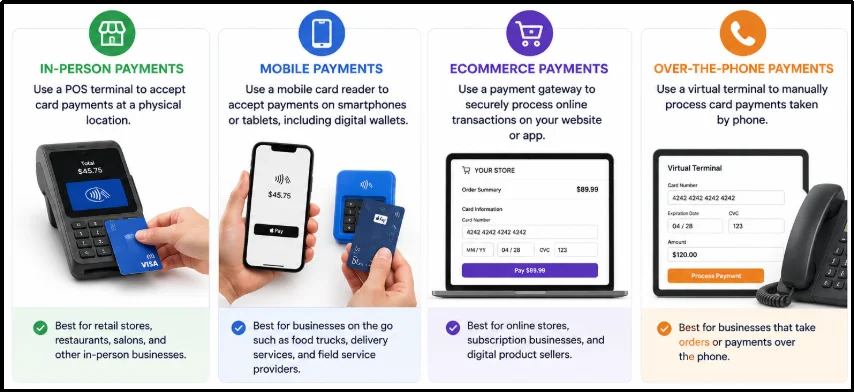
The following are some of the payment processing solutions you might need:
- In-Person Payments: Use a POS terminal to accept card payments at a physical location.
- Mobile Payments: Use a mobile card reader to accept payments on smartphones or tablets, including digital wallets.
- Ecommerce Payments: Use a payment gateway to securely process online transactions.
- Over-the-Phone Payments: Use a virtual terminal to manually process card payments taken by phone.
You may also need specific hardware or software from your merchant service provider. Understanding these needs upfront will help you avoid unnecessary expenses and streamline the payment process.
Step #2: Register Your Business
First, you need to register your business with the appropriate government authorities. This process includes obtaining necessary licenses, permits, and tax identification numbers. The requirements vary based on your business type and location, so it’s essential to check local regulations.
- Legal Structure: Decide whether your business will operate as a sole proprietorship, LLC, or corporation, as this affects tax obligations and liability.
- Business License: Many industries require a business license to operate legally. Research state and local requirements to stay compliant.
- Employer Identification Number (EIN): Most businesses need a tax identification number. In the United States, this is typically an Employer Identification Number (EIN) issued by the IRS. Other countries may require a different business tax ID.
- State Registration: Some businesses must register with state agencies, particularly if they plan to collect sales tax or hire employees.
Having your business legally registered makes it easier to navigate financial transactions and maintain compliance with banking regulations.
One of the most commonly asked questions is: How Long Does Approval Take?
Payment service providers like Square and Stripe can approve accounts within minutes, while traditional banks typically take 2–10 business days. High-risk merchant accounts require additional underwriting and may take 1–3 weeks to be approved.
Step #3: Choose a Merchant Account Provider
Selecting the right merchant account provider plays a key role in how efficiently your business can process payments. Since not all providers offer the same features, it’s essential to evaluate your options carefully.
When comparing merchant account providers, focus on these key factors:
- Fees: Compare transaction fees, monthly charges, and any setup or hidden costs.
- Processing Speed: Check how quickly funds are deposited into your business account.
- Customer Support: Choose a provider with responsive support via phone, email, or live chat.
- Security: Look for PCI compliance, encryption, and fraud protection features.
- Integrations: Ensure it works with your POS system, website, or ecommerce platform.
- Reputation: Read customer reviews to evaluate reliability and service quality.
If you want a faster setup, payment service providers like Square, Stripe, and PayPal offer payment processing without requiring a traditional merchant account, making them a popular choice for many businesses.
Step #4: Submit Your Merchant Application
Opening a merchant account used to be a lengthy and complex process, requiring different verifications, checks, and paperwork. However, today the application process is much faster and more accessible.
Now, businesses can apply online and receive approval within minutes, depending on the provider.
Follow the process mentioned below to submit your merchant application:
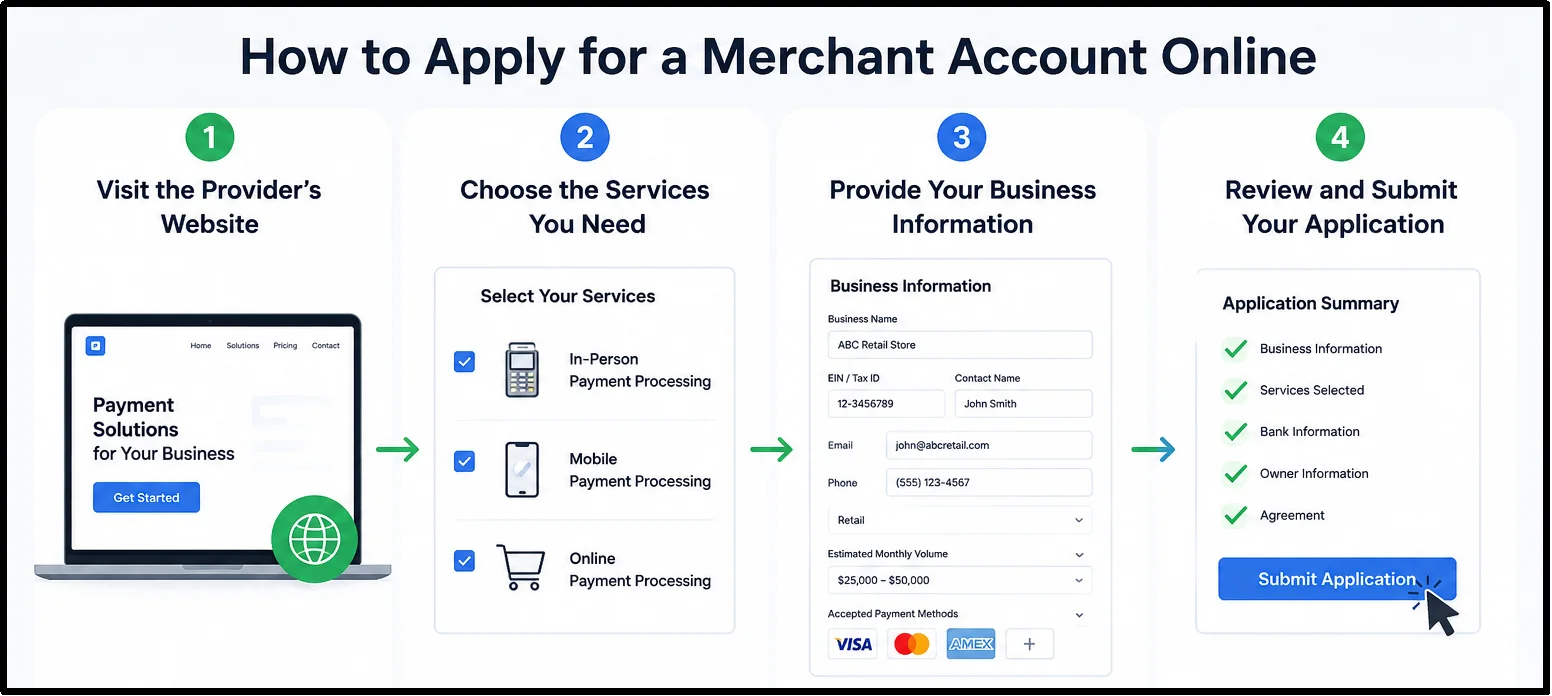
- Visit the provider’s website and start the online application.
- Choose the services you need, such as in-person, mobile, or online payment processing.
- Provide your business information, including your business name, EIN or tax ID, contact details, industry, estimated transaction volume, and accepted payment methods. Some providers may also request the business owner’s personal information for verification.
- Review and submit your application. After submission, the provider will verify your information, complete underwriting if required, and notify you once your merchant account is approved.
Expert Tip
Merchant account approval often depends more on business legitimacy than business size. Businesses with a professional website, transparent refund policies, and complete documentation typically experience faster approvals and fewer underwriting delays.
Step #5: Provide the Required Documents
After completing your application, you must provide supporting documents. The specific requirements may vary by provider and business type, but common documents include:
- Business registration documents – Articles of incorporation, business licenses, or other proof of legal registration.
- Employer Identification Number (EIN) – A tax ID issued by the IRS for business identification.
- Financial statements – Business bank account statements, income statements, and cash flow records.
- Processing history – Records of past credit card transactions, especially if switching providers.
- Additional documents – A voided check, business plan, marketing materials, or industry-specific certifications.
Once the provider receives your documents, they will begin underwriting. This step evaluates your business’s risk level and helps determine whether your application will be approved.
The process may involve:
- Credit checks – The provider may assess your personal and business credit history.
- Sales volume review – They might analyze expected transaction volume and average ticket size.
- Chargeback risk assessment – Businesses with high refund or chargeback rates may undergo extra scrutiny.
Underwriting can take anywhere from a few minutes to several business days, depending on your provider and industry. High-risk businesses may experience a longer review process.
If the provider requires more details, they will reach out for clarification or extra documents. Respond promptly to avoid unnecessary delays. Once everything is verified, your merchant account application can move forward to approval.
Step #6: Configure Payment Processing (After Approval)
After your merchant account is approved, the next step is to set up payment processing with your provider.
Generally, you need to go through the following:
- Integrate your payment gateway with your website, ecommerce platform, or POS system. Most providers offer plugins or APIs for quick and seamless integration.
- Enable your preferred payment methods, such as credit and debit cards, digital wallets (Apple Pay and Google Pay), and ACH transfers, based on your customers’ preferences.
- Test your payment system by running a few sample transactions to verify that payments are processed correctly and funds are routed to your business account before you start accepting live payments.
Businesses that accept card payments should maintain PCI DSS compliance. PCI compliance helps protect customer payment data and reduces the risk of security breaches and fraud.
High-Risk vs Low-Risk Merchant Accounts
Not all businesses receive the same approval process.
Providers classify businesses based on risk factors such as:
- Industry type
- Average transaction value
- Chargeback history
- Processing volume
- Business age
Examples of high-risk industries include:
- Travel
- Subscription services
- CBD businesses
- Online gaming
- Adult services
High-risk businesses often undergo stricter underwriting and may pay higher processing fees.
Why Merchant Account Applications Get Rejected
Merchant account providers may reject applications for several reasons:
- Poor personal credit history
- Incomplete documentation
- High-risk business activities
- Excessive chargeback history
- Lack of business registration
- Suspicious transaction patterns
Before applying, ensure your documents are accurate and your business information matches official records.
You Don’t Need a Merchant Account with Square
If you don’t want to go through the lengthy process of opening a merchant account, Square offers a simpler solution. Unlike traditional merchant accounts, Square provides built-in payment processing, allowing businesses to accept credit and debit card payments without dealing with banks or payment processors separately.
To accept Square payments in WordPress, you need to install WP Easy Pay. This powerful plugin integrates Square with your WordPress site, enabling you to collect payments through one-time charges, recurring subscriptions, and donation forms.
So, what’s holding you back?
Download WP Easy Pay now and start accepting Square payments without requiring a merchant account.
Frequently Asked Questions
Can I get a merchant account with a new business?
Yes. Many payment providers accept newly established businesses, although they may request additional business details or place temporary limits until your account has a processing history.
Can I have more than one merchant account?
Yes. Some businesses use multiple merchant accounts to support different brands, currencies, or sales channels. Make sure each account complies with the provider’s terms and conditions.
Does my personal credit score affect merchant account approval?
It can, depending on the provider. Some traditional merchant account providers review the business owner’s credit history, while many modern payment providers focus more on the business model and risk profile.
Can I accept international payments with a merchant account?
In many cases, yes. However, the countries, currencies, and payment methods supported depend on your payment provider and where your business is registered.
What happens if my merchant account application is rejected?
If your application is declined, ask the provider for the reason. You may be able to reapply after providing additional documents or choose another provider that better fits your business type.
Is a merchant account the same as a business bank account?
No. A merchant account is used to process card payments, while a business bank account is where your funds are ultimately deposited after settlement.
Can freelancers and sole proprietors get a merchant account?
Yes. Many payment providers support sole proprietors and freelancers, although the eligibility requirements vary by country and provider.
Do merchant accounts support recurring payments?
Many merchant accounts work with payment gateways that support recurring billing for subscriptions and memberships. Check whether your chosen payment provider includes this feature.
Are merchant accounts secure for online payments?
Yes. Reputable providers use encryption, fraud detection tools, and industry security standards to help protect payment data. Businesses should also follow payment security best practices.
How can I reduce the chances of chargebacks on my merchant account?
Provide accurate product descriptions, communicate clearly with customers, deliver orders on time, and respond quickly to customer issues. Keeping clear transaction records can also help if a dispute occurs.
Can I Get a Merchant Account Without an LLC?
Yes. Many providers allow sole proprietors, freelancers, and self-employed individuals to apply for merchant accounts without forming an LLC.
Do I Need a Merchant Account for Shopify?
Not necessarily. Shopify Payments allows merchants to accept payments without opening a separate merchant account in many regions.
What Documents Do I Need for Merchant Account Approval?
Most providers request:
- Business registration documents
- Tax identification number
- Government-issued identification
- Business bank account details
- Financial records