


Want to accept ACH payments in WordPress?
You can do it with WP Easy Pay, a WordPress payment form plugin that connects your site to Square. Connect your Square account, enable ACH Debit, create your payment form, and test the checkout before you accept real payments.
ACH gives customers another way to pay when they don’t want to use a credit or debit card. But ACH doesn’t behave exactly like a card payment.
In this guide, you’ll learn how to accept ACH payments in WordPress in three steps, how ACH works, what Square currently charges, how to test the payment flow, what the main payment statuses mean, and how to troubleshoot common ACH problems.
Quick Answer: How to Accept ACH Payments in WordPress
To accept ACH payments in WordPress with WP Easy Pay and Square:
- Install WP Easy Pay and connect your Square account.
- Connect WP Easy Pay to Square and Enable ACH Payments
- Create, Publish a Payment Form, and Start Accepting ACH Payments
WP Easy Pay supports ACH payments through Square, subject to payment method availability in your account and location.
What Is an ACH Payment?
ACH stands for Automated Clearing House.
The ACH Network is a U.S. electronic payment network that moves money between participating banks and credit unions. ACH supports both credits, where money moves into an account, and debits, where an authorized payment pulls money from an account.
For WordPress businesses collecting money from customers, ACH Debit is the relevant payment type.
Instead of paying with a card, the customer authorizes a payment from a bank account.
A simplified Square payment flow looks like this:
Customer selects ACH Debit → Customer authorizes the bank payment → Square processes the ACH payment → ACH and banking systems process the transfer → Square updates the payment status → Funds become available according to the processor’s settlement process
The exact technical flow can vary by payment provider and integration.
ACH Debit vs. ACH Credit
ACH has two broad transaction types.
ACH credit pushes money into another account.
ACH debit pulls an authorized payment from a customer’s account.
For an online payment form, ACH Debit is the relevant option when the customer authorizes you to collect a payment from their bank account.
ACH vs. Bank Transfer
People sometimes use “ACH,” “bank transfer,” “eCheck,” and “pay by bank” as if they’re identical.
They’re not always interchangeable.
ACH specifically refers to transactions that use the ACH Network. A wire transfer uses a different payment rail, while a pay-by-bank experience can use ACH or another payment network depending on the provider.
For this WordPress setup, ACH Debit is the clearest term because that’s the payment method WP Easy Pay exposes through its Square integration.
ACH vs. eCheck
An eCheck and an ACH payment can overlap, but the terms don’t mean exactly the same thing in every context.
ACH describes the payment network and transaction method, while eCheck commonly describes an electronic version of a paper check that may use ACH processing.
For this guide, ACH payment refers specifically to the ACH payment method supported through the Square and WP Easy Pay integration.
When ACH Payments Make Sense for a WordPress Business
ACH doesn’t need to replace cards. It gives customers another choice.
Businesses often consider ACH for:
- Large invoices
- B2B transactions
- Memberships
- Recurring services
- Subscriptions
- Donations
- Consulting payments
- Service deposits
- High-value transactions
ACH can work particularly well when customers already prefer paying from a bank account or when your business regularly handles larger payments.
Potentially Lower Processing Costs
ACH pricing can differ from card pricing.
Square currently lists ACH bank transfers through its API at 1% per transaction, with a $1 minimum and a $5 fee cap. Square lists different terms for ACH payments made through invoices, so the exact pricing depends on the Square payment flow and plan you use.
Don’t assume that rate applies to every Square ACH payment flow.
Third-party payment processors can change pricing, and your account may have terms that differ from the standard public rate.
Useful for Recurring Payments
Customers who pay a membership, subscription, retainer, or recurring service may prefer a bank-account payment.
WP Easy Pay also supports recurring payments as part of its payment functionality.
But test the recurring workflow separately.
A one-time ACH payment and a recurring billing workflow can involve different customer and payment states.
Another Option Alongside Cards
You don’t have to choose between ACH and cards.
A checkout can offer both: Credit/debit card + ACH Debit
That gives customers more flexibility without forcing every transaction through the same payment method.
What Do You Need to Accept ACH Payments in WordPress?
Before you start, make sure you have:
- A WordPress website
- A compatible Square account
- WP Easy Pay, a WordPress payment form plugin
- ACH eligibility through Square
- A payment form
- A valid HTTPS-enabled website
WP Easy Pay connects to Square through OAuth and supports both Live Mode and Test Mode/Sandbox connections. Its documentation also recommends selecting the correct Square business location after connecting the account.
How to Accept ACH Payments in WordPress in 3 Steps
Once you’ve chosen ACH as a payment option, the next step is to connect it to your WordPress site and make it available to customers.
You don’t need to build the payment flow from scratch. With WP Easy Pay and Square, you can connect your account, configure ACH payments, and add the payment form to your site.
Let’s walk through each step.
Step 1: Install WP Easy Pay and Connect Square
Start by installing WP Easy Pay Pro on the WordPress site where you want to collect payments.
Head to the WP Easy Pay pricing page and choose a plan that includes the ACH features you need. You will receive an email with the WP Easy Pay Premium ZIP file; keep your license key nearby for later use.
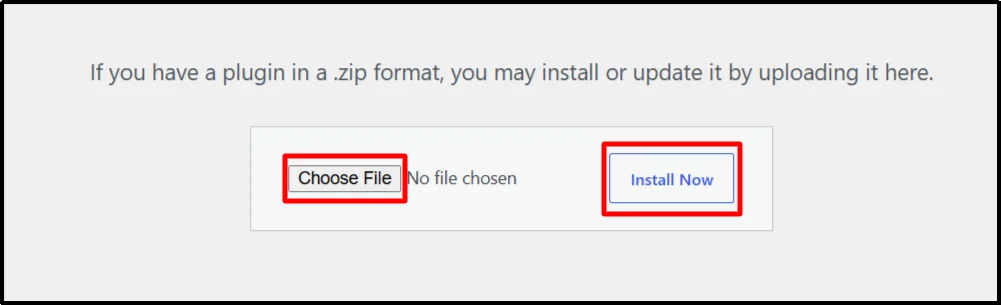
- Go to Plugins → Add Plugin.
- Click Upload Plugin.
- Click Choose File. Select the WP Easy Pay ZIP file, and click Install Now.
- Click Activate Plugin.
- Enter the key provided with your purchase.
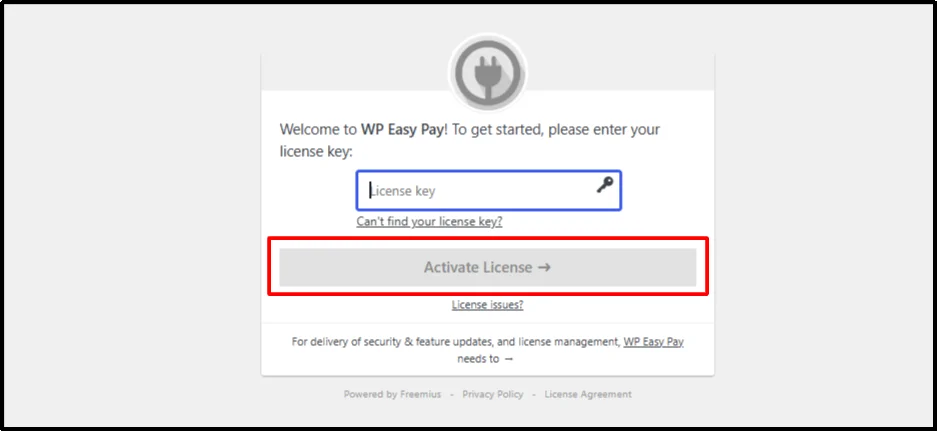
- Click Activate License.
After activation, your next step is to connect your Square account and enable ACH payments in WP Easy Pay.
Step 2: Connect WP Easy Pay to Square and Enable ACH Payments
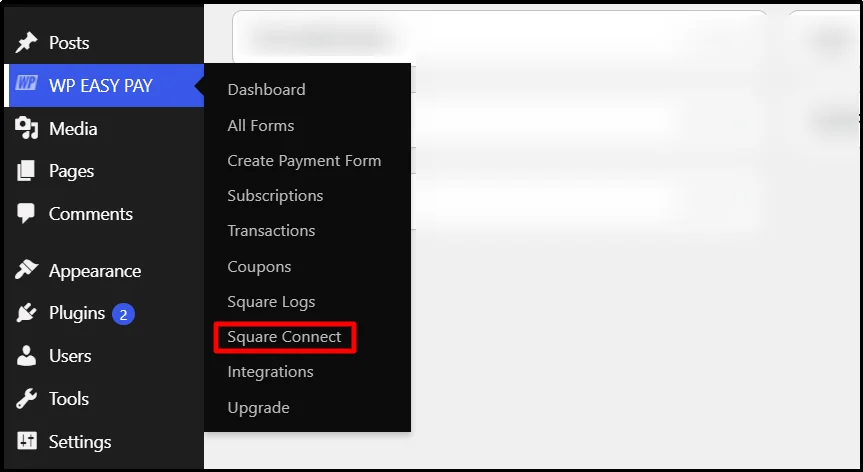
- Go to WP Easy Pay → Square Connect.
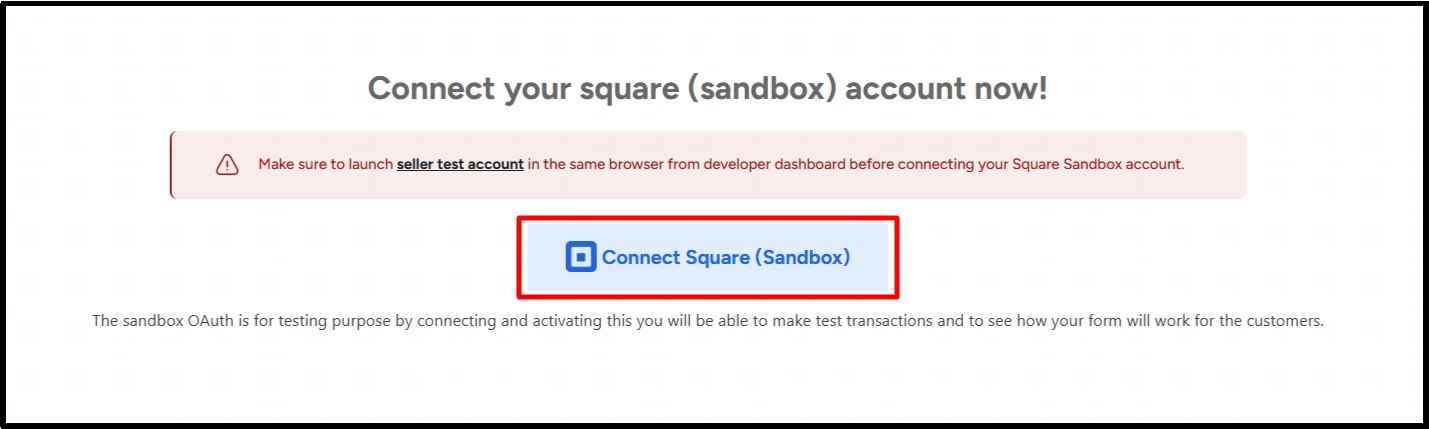
- Select the appropriate Test (Sandbox) or Live environment.
- Click the Connect Square button.
- Sign in to the intended Square account.
- Approve the authorization request.
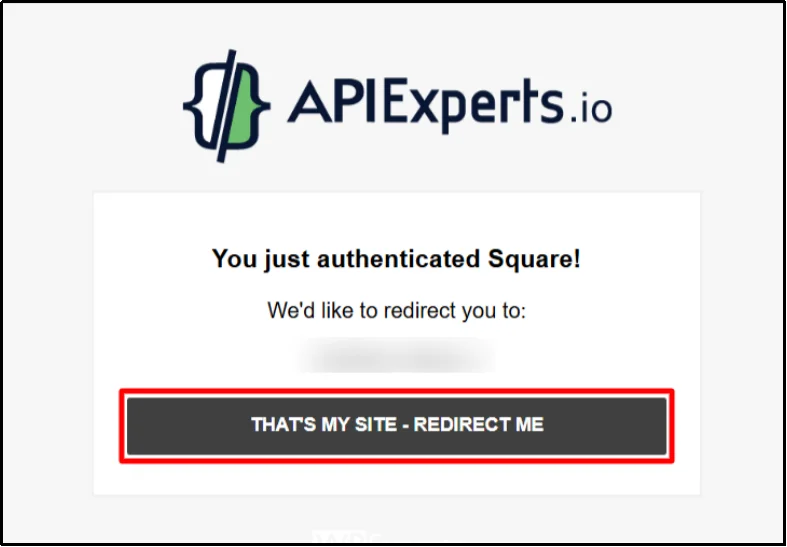
- Select THAT’S MY SITE – REDIRECT ME to return to your WordPress dashboard.
- Select the correct Square business location, and save the settings.
Once Square connects, enable ACH Debit.
- Navigate to WP Easy Pay → Square Connect.
- You’ll reach the Square Payment Gateway Settings area, where you can find the ACH Debit Payment option.
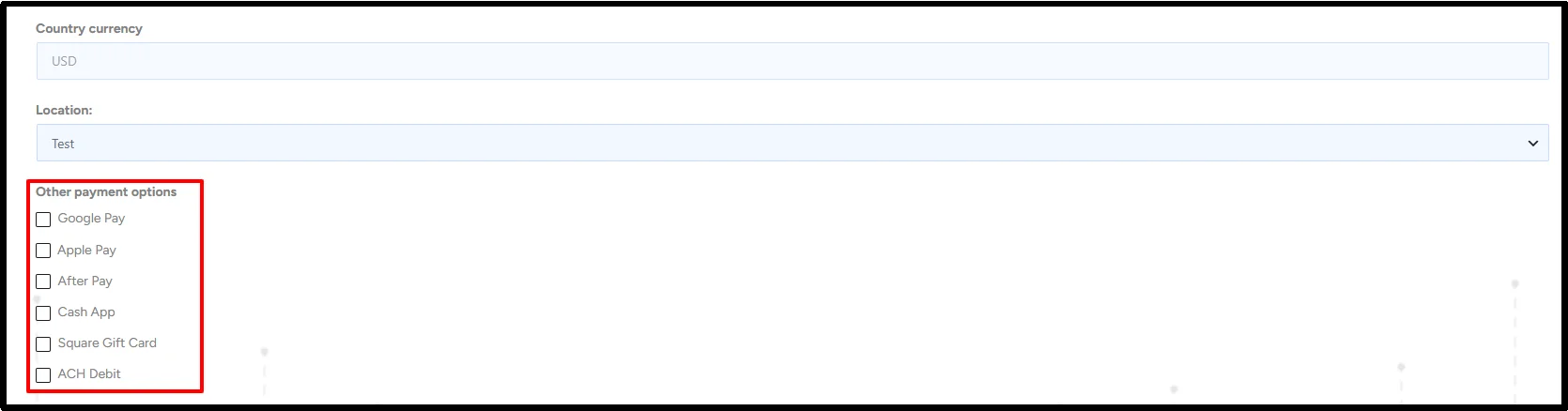
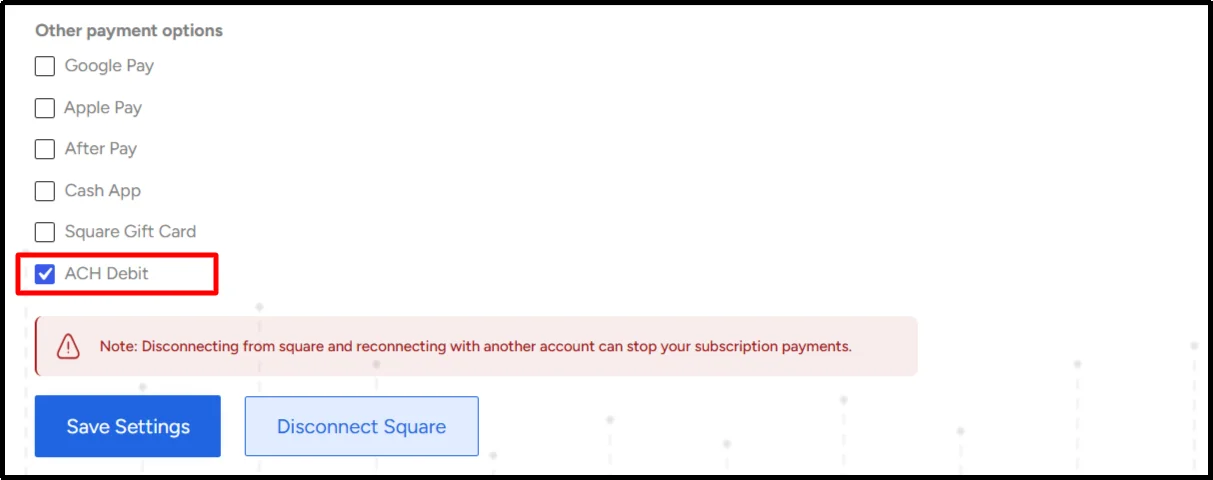
- Locate ACH Debit Payment.
- Enable the option.
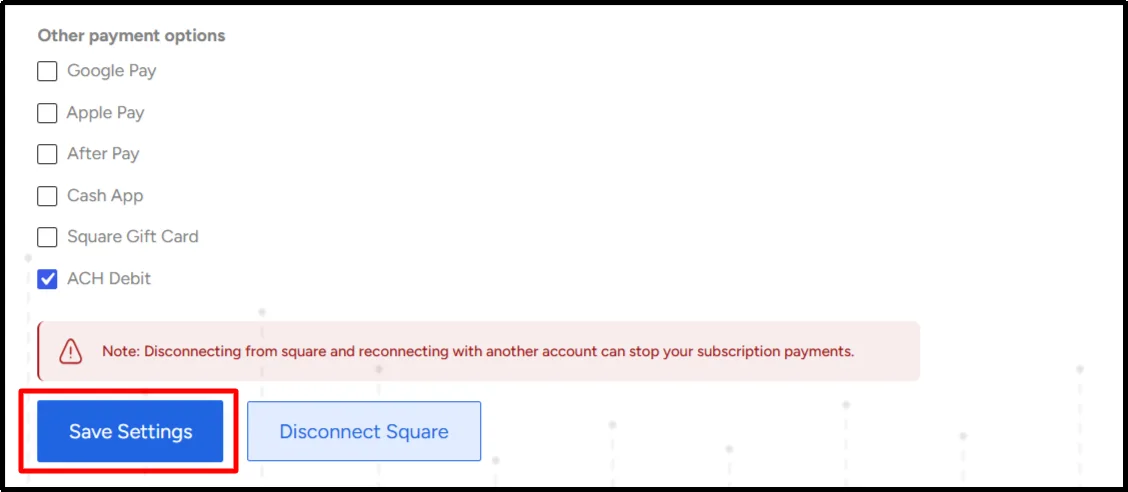
- Click Save Settings.
Now create the payment form that customers will use.
Your form should collect the information required for the transaction. If you’re collecting a simple payment, don’t ask for ten fields that your business won’t use.
Step 3: Create, Publish, and Start Accepting ACH Payments
Once ACH Debit is enabled, customers can choose it from the supported payment methods on your form.
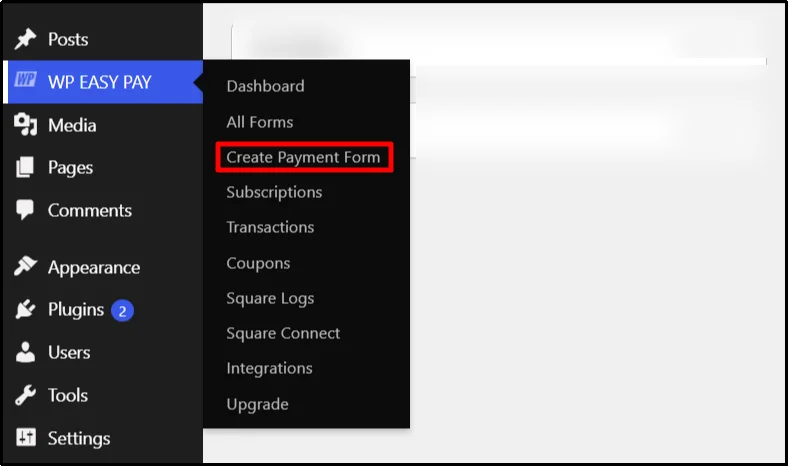
- Go to WP Easy Pay → Create Payment Form.
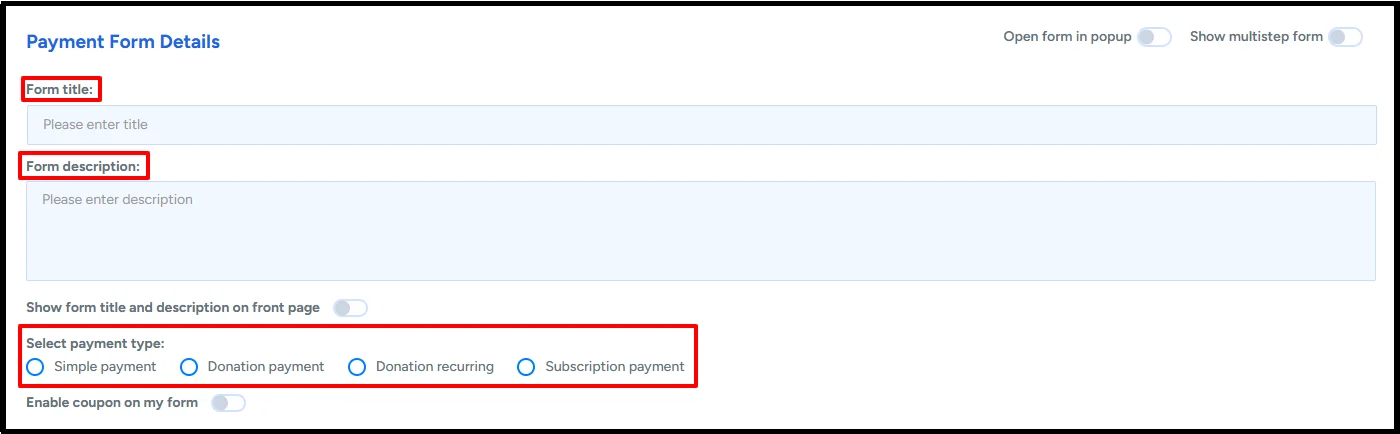
- Enter the required information — form title, description, and payment type.
- Select the amount type and enter the payment amounts you want to offer.

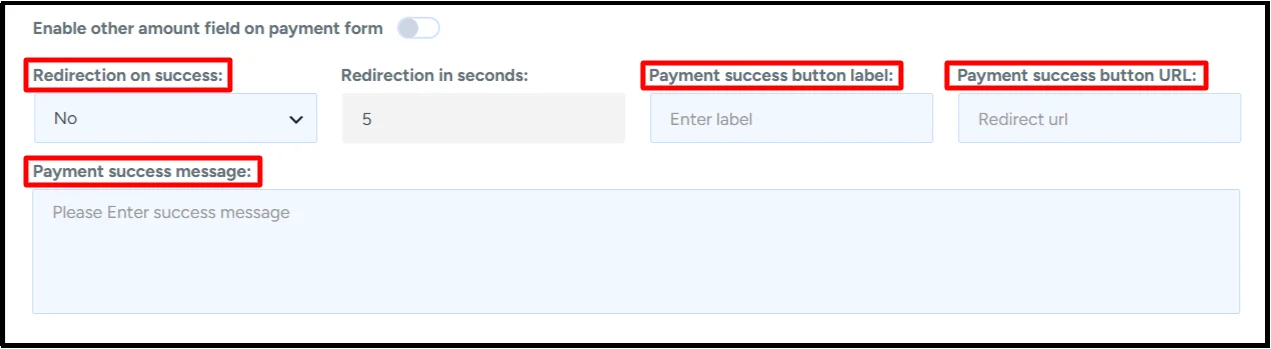
- Configure whether you want to enable Redirection on Success and set your payment success messages.
- Double-check the form details, then click Publish.
Your ACH-enabled payment form is now published.
Before accepting real payments, test the complete ACH checkout in Sandbox and verify the transaction in Square.
Publishing the form doesn’t mean you’re accepting real payments. If your Square connection remains in Test Mode, you can use the published form to test the payment flow without processing a live customer payment.
How ACH Payments Work After a Customer Submits the Form
ACH doesn’t behave like an instant card authorization. The payment can move through several stages.
The ACH payment workflow looks like this:
Customer selects ACH Debit
↓
Customer connects or verifies a bank account
↓
Customer authorizes the payment
↓
Square processes the ACH payment
↓
Payment status changes
↓
Funds become available according to the processor’s settlement process
Square describes ACH payments as asynchronous and says they can take two to three business days to complete. Square’s documentation also explains that an ACH payment can begin in a PENDING state before moving to COMPLETED or FAILED.
Understanding ACH Payment Statuses
Payment status matters more with ACH because the transaction doesn’t necessarily finish during the customer’s checkout session.
Pending → The ACH payment still needs processing or confirmation.
Completed → Square has completed the payment according to its payment-processing workflow.
Failed → The ACH payment didn’t complete successfully.
What About ACH Returns?
An ACH return is different from the basic PENDING, COMPLETED, and FAILED payment statuses.
A transaction can encounter a return after submission, so don’t treat a customer’s initial confirmation screen as proof that the funds have permanently settled.
ACH One-Time vs. Recurring Payments
ACH can support both one-time and recurring payment scenarios, but your business should configure each workflow around its actual billing model.
One-Time ACH Payments
One-time payments can work well for:
- Large invoices
- Service deposits
- Consulting payments
- Donations
- Custom orders
- B2B transactions
The customer authorizes the transaction for that payment.
Recurring ACH Payments
Recurring ACH can fit:
- Monthly memberships
- Subscription services
- Retainers
- Recurring donations
- Maintenance plans
- Scheduled services
WP Easy Pay supports recurring payments, and its Sandbox resources recommend testing recurring payment behavior before launch.
Test it separately.
A successful one-time payment doesn’t prove that the recurring workflow works correctly.
ACH vs. Credit Card Payments
ACH and credit card payments both help you collect money online, but they use different payment methods and customer flows.
| Factor | ACH Debit | Credit/Debit Card |
| Payment source | Bank account | Card account |
| Payment network | ACH Network | Card network |
| Customer flow | Bank connection/authorization | Card entry or saved payment method |
| Payment confirmation | Can take longer | Usually occurs during checkout |
| Pricing | Depends on processor and payment flow | Depends on processor and card type |
| Large transactions | Can fit some high-value payments | Percentage fees can increase with transaction value |
| Recurring payments | Common use case | Common use case |
| Geographic scope | U.S. ACH Network | Generally broader |
For many WordPress businesses, the practical choice is to offer both.
How Much Does It Cost to Accept ACH Payments?
ACH pricing depends on the payment processor, payment channel, account plan, and transaction type.
Square currently lists:
- ACH bank transfer via API: 1% per transaction, $1 minimum, $5 fee cap
- ACH bank transfer via invoice: 1% per transaction, with minimum and cap details that vary by Square plan
- ACH transactions deposited into Square Checking: Square currently lists $0 processing fees for those transactions under the listed plans
Square’s pricing can vary by payment flow and plan, so check the current pricing shown for your account before publishing an exact ACH processing fee.
Square also lists a $50,000 transaction cap for its ACH payment offering, although limits and eligibility can change. Check your current Square account terms before accepting a large payment.
Common ACH Payment Problems in WordPress
ACH payments usually work smoothly once you configure your Square connection, account eligibility, and WP Easy Pay settings correctly.
If something goes wrong, check these common issues first.
1. ACH Debit Doesn’t Appear
If ACH isn’t available on your payment form, check:
- Your Square account eligibility and region
- The selected Square business location
- Your Square connection
- WP Easy Pay’s ACH settings
- Whether you’re using Test or Live Mode
ACH availability depends on your Square account and location.
2. Square Connection Isn’t Working
Make sure you’re connected to the correct Square account and location.
Also verify that WP Easy Pay completed the OAuth connection and that your Square account is active.
3. ACH Payment Is Still Pending
A pending ACH payment doesn’t necessarily mean the payment failed.
ACH transactions can remain pending while the bank processes them before reaching a completed or failed status.
Check the transaction in Square and use its current status to determine the next step. ACH payments can take several business days to complete.
4. Bank Verification Fails
If the customer can’t complete bank verification, ask them to check their bank details and try again.
They may also need to choose another available verification method.
5. ACH Payment Fails
Check the transaction status and failure reason in Square.
Depending on the reason, you may need to ask the customer to retry the payment or use another payment method.
Don’t assume that submitting the payment form means the funds have settled.
6. Test Mode Works but Live Mode Doesn’t
If ACH works in Sandbox but not in Live Mode, compare your Live configuration with your test setup.
Check your:
- Live Square account
- Business location
- ACH eligibility
- Payment settings
- WP Easy Pay environment
A successful Sandbox test confirms the test workflow, but it doesn’t guarantee that your Live account has the same ACH eligibility or settings.
ACH Payment Terms You Should Know
If you’re new to ACH payment processing, these terms help.
| Term | Meaning |
| ACH | Automated Clearing House, the U.S. electronic payment network |
| ACH Debit | A payment that pulls authorized funds from a bank account |
| ACH Credit | A payment that pushes funds into a bank account |
| ACH Network | The network used to process ACH transactions |
| Bank Verification | The process of confirming or connecting a customer’s bank account |
| Pending | The payment still requires processing or confirmation |
| Completed | The processor has reached its completed payment state |
| Failed | The payment didn’t complete successfully |
| Settlement | The process through which funds become available according to the payment provider’s rules |
| Same Day ACH | ACH processing that can settle within hours on the same banking day in eligible cases |
Nacha says the ACH Network reaches U.S. bank and credit union accounts and supports recurring and scheduled transactions.
Accept ACH Payments in WordPress With WP Easy Pay
Accepting ACH payments in WordPress doesn’t require you to build a bank-payment system from scratch.
With WP Easy Pay and Square, the setup is straightforward.
The payment timing needs more attention.
Make sure your Square account qualifies for ACH, explain the bank-account authorization process to customers, test payment statuses, and don’t promise a settlement time your processor hasn’t provided.
Start in the Sandbox.
Then switch to Live Mode when the entire payment journey works as expected.
Frequently Asked Questions
Can I offer ACH and credit cards on the same WordPress form?
Yes, when your WP Easy Pay supports both payment methods. Offering both lets customers choose between a bank-account payment and a card instead of forcing everyone through one checkout method.
Do I need a Square account to use ACH with WP Easy Pay?
Yes. WP Easy Pay integrates ACH Debit through Square, so you’ll need a compatible Square account and ACH eligibility before you can enable the payment method.
How long do ACH payments take?
Square says ACH payments typically take two to three business days to complete or arrive in your Square account, depending on the payment flow.
Sandbox payments use a much shorter testing timeframe, so don’t use Sandbox timing as a prediction for live transactions.