




Choosing between SumUp and Square isn’t easy. Both payment processors offer card readers, POS software, online payment tools, and business management features. However, they differ significantly in transaction fees, hardware options, inventory management capabilities, eCommerce integrations, and scalability.
In this detailed SumUp vs Square comparison, we’ll compare pricing, POS features, card readers, payment processing costs, integrations, customer support, and WordPress compatibility to help you choose the best payment solution for your business.
SumUp vs Square: Quick Verdict
| Best For | Winner |
| Lowest Startup Cost | SumUp |
| POS Features | Square |
| Inventory Management | Square |
| Online Selling | Square |
| WordPress Integration | Square |
| Customer Support | Square |
| Growing Businesses | Square |
| Solo Merchants | SumUp |
How We Compared SumUp and Square
To create this comparison, we evaluated SumUp and Square based on pricing, transaction fees, POS functionality, payment methods, hardware options, integrations, customer support, and business scalability. We also reviewed official product documentation, pricing information, and available integration options to ensure accuracy.
A Brief History of Both Platforms
Before comparing features and pricing, it helps to know where these two platforms came from and what has shaped their approaches to payments.
SumUp
- Founded in London in 2012 by Daniel Klein, Marc-Alexander Christ, and Stefan Jeschonnek
- Built with a clear mission: make card payments accessible and affordable for small businesses
- Launched its first card reader across 10 European countries, letting merchants accept payments via smartphone or tablet
- Skipped expensive terminals from day one, keeping setup simple and low-cost
- Has since grown to serve over 4 million businesses across 36 markets worldwide
Square
- Founded in 2009 by Jack Dorsey and Jim McKelvey
- Created to help small businesses accept credit card payments without costly equipment
- Introduced a compact card reader that plugged into mobile devices, making card acceptance affordable for the first time
- Expanded over time into inventory management, sales reporting, and customer engagement tools
- Rebranded its parent company as Block, Inc. in December 2021, with Square continuing as one of its core products
💡 Learn more about Square: What is Square? Detailed Look at Features [2026]
Pricing & Transaction Fees
Pricing is often the deciding factor when choosing a payment provider, so let’s break down what each platform actually charges.
SumUp’s Pricing Model
SumUp keeps things simple with no monthly fees for basic use; you only pay when a transaction goes through.
- In-person payments (tap, dip, or swipe via SumUp card reader): 2.60% + 10¢ per transaction
- Online or remote payments (no card present): higher rate applies, typically in the 3.5% range
- Cash payments: no fees at all
- Refunded or declined transactions: you’re not charged
For businesses wanting more built-in tools, SumUp also offers POS subscription plans (Connect Lite, Plus, and Pro) with features like customer rewards and automated marketing layered on top of the base transaction fee.
Square’s Pricing Model
Square also keeps pricing transparent, with rates that shift slightly depending on your plan (Free, Plus, or Premium) and how the payment is taken.
- In-person payments: 2.6% + 15¢ on the Free plan, dropping as low as 2.4% + 15¢ on Premium
- Online payments (Square Online or eCommerce API): 3.3% + 30¢ on Free, 2.9% + 30¢ on Plus and Premium
- Invoices: 3.3% + 30¢ per paid invoice
- ACH bank transfers: 1%, with a $1 minimum
- Manually entered or card-on-file payments: 3.5% + 15¢
Businesses processing over $250,000 annually can also request custom pricing from Square’s sales team.
Comparison of Transaction Fees
For straightforward in-person transactions, both platforms land in a similar range, so neither has a dramatic edge there. Where things diverge slightly is online and remote payments, where rates and structures vary based on plan type and transaction volume.
| Transaction Type | SumUp | Square |
| In-person (card present) | 2.60% + 10¢ | 2.6% + 15¢ (Free) |
| Online / remote payments | ~3.5% | 3.3% + 30¢ (Free) |
| Invoices | Varies by plan | 3.3% + 30¢ |
| Manually entered card | ~3.5% | 3.5% + 15¢ |
| ACH bank transfer | Not offered | 1% (min $1) |
| Monthly subscription | $0–$289 (optional plans) | $0–$149 (per location) |
Since there isn’t a noticeable difference between the two here, let’s jump into other aspects and look for unique features and ease of integration.
Card Reader & Hardware Comparison
SumUp Hardware
- SumUp Solo
- SumUp Plus
- SumUp Air
Square Hardware
- Square Reader
- Square Terminal
- Square Register
- Square Stand
Recommendation
Square offers a wider range of hardware solutions, making it a better option for retailers, restaurants, and businesses with multiple checkout stations.
Features & Integrations
Beyond pricing, the right platform should also fit how you actually run your business day-to-day. Here’s how SumUp and Square compare on the features, integrations, and support that matter most.
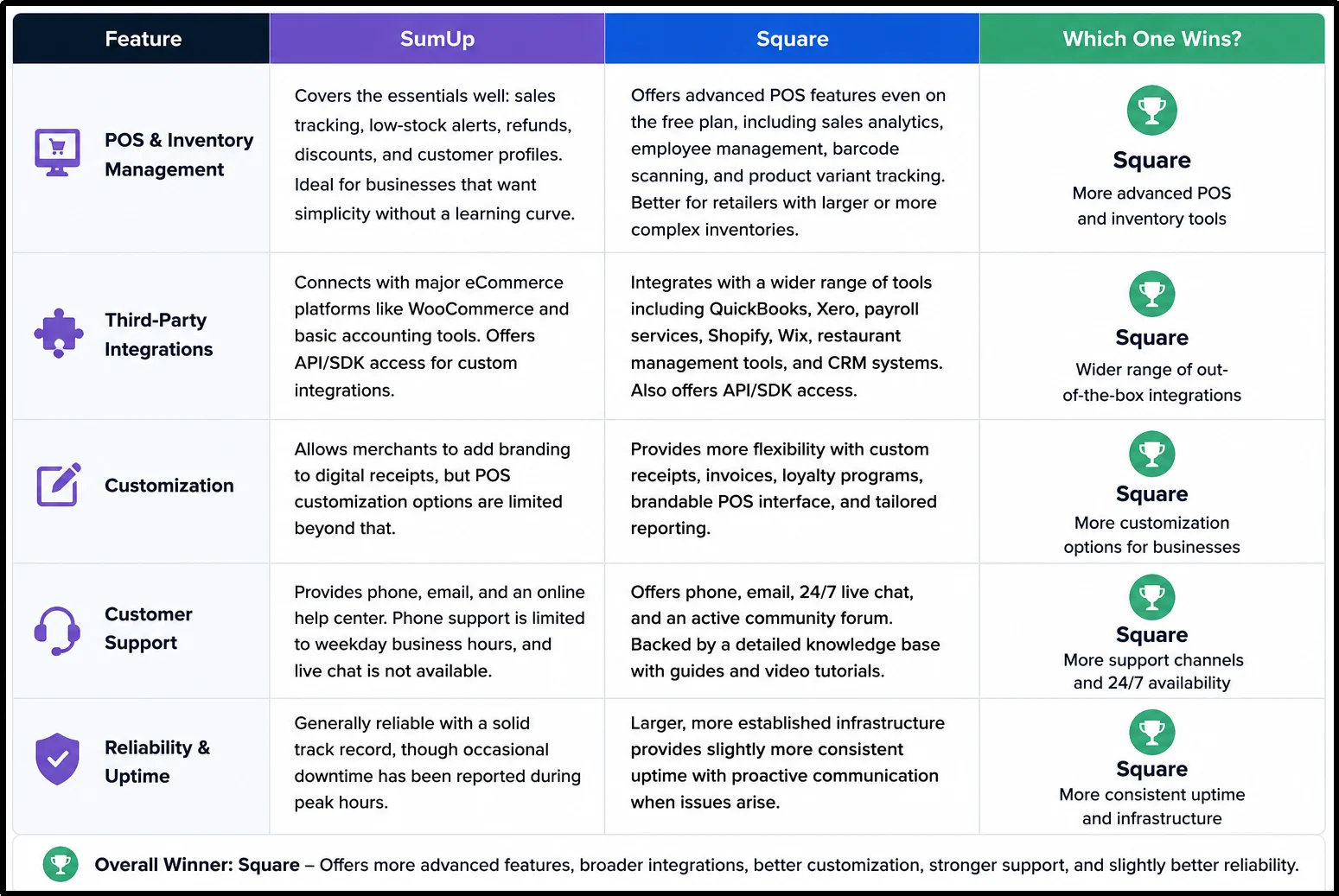
POS and Inventory Management
SumUp’s POS covers the essentials well: sales tracking, low-stock alerts, refunds, discounts, and customer profiles, making it a solid fit for businesses that want simplicity without a learning curve.
Square’s POS goes further, even on its free plan, with sales analytics, employee management, barcode scanning, and product variant tracking. That extra depth makes it a better fit for retailers managing larger or more complex inventories.
Third-Party Integrations
SumUp connects with major eCommerce platforms like WooCommerce and basic accounting tools and offers API/SDK access for businesses building custom solutions.
Square covers similar ground but with a wider net, integrating with QuickBooks, Xero, payroll services, Shopify, Wix, restaurant management tools, and CRM systems. Since both offer API/SDK access, they’re fairly evenly matched here, though Square covers more out-of-the-box use cases.
Customization
SumUp lets merchants add branding to digital receipts, but POS customization options are fairly limited beyond that.
Square offers noticeably more flexibility, custom receipts, invoices, loyalty programs, a brandable POS interface, and tailored reporting, giving businesses more control over how their setup looks and feels.
Customer Support
SumUp provides phone, email, and an online help center, but phone support is limited to weekday business hours, and live chat isn’t available, which can be a drawback for businesses operating in the evenings or on weekends.
Square offers a broader support system, including phone, email, 24/7 live chat, and an active community forum, backed by a detailed knowledge base of guides and video tutorials. Overall, it’s the more accessible option of the two.
Reliability and Uptime
Both platforms maintain strong uptime records and process millions of transactions annually. While occasional service interruptions can affect any payment provider, both SumUp and Square offer reliable payment processing for everyday business operations.
SumUp vs Square for WordPress
If you run a WordPress website, integration flexibility becomes important.
Square integrates directly with:
- WooCommerce
- WP Easy Pay
- Gravity Forms
- Formidable Forms
- MemberPress
With WP Easy Pay, you can:
- Accept one-time payments
- Create payment forms
- Accept donations
- Sell products and services
- Embed Square payment forms anywhere on WordPress
While SumUp supports online payments, its WordPress ecosystem remains more limited compared to Square.
Final Verdict: Is SumUp or Square Better?
SumUp and Square both provide reliable payment processing solutions, but they target slightly different audiences.
Choose SumUp if:
- You want a simple card payment solution
- You process a lower transaction volume
- You want minimal upfront costs
Choose Square if:
- You need advanced POS features
- You manage inventory
- You sell online and offline
- You need extensive integrations
- You plan to scale your business
For most growing businesses, Square delivers greater long-term value thanks to its advanced POS system, broader integrations, stronger inventory management tools, and larger ecosystem.
Don’t forget to check out our other articles in this series:
- Square vs PayPal: Which is Right for Your Business?
- Square vs Shopify: Detailed Comparison [2026]
- Clover vs. Square: Which Is The Best For Your Business?
To accept payments via Square on your WordPress site, try WP Easy Pay today!
Frequently Asked Questions
Is SumUp cheaper than Square?
It depends on how you take payments. SumUp’s in-person rate (2.60% + 10¢) is close to Square’s (2.6% + 15¢), but SumUp typically charges more for online transactions. Your actual costs will vary based on transaction volume and average sale size.
Does SumUp or Square work better for online stores?
Square generally has an edge for online selling, with broader eCommerce integrations (Shopify, WooCommerce, Wix) and a more built-out online store platform. SumUp supports online payments too, but its toolset is less extensive.
Can I use SumUp or Square with WordPress?
Yes, both can be connected to WordPress, though the ease of setup varies by provider and plugin. Tools like WP Easy Pay simplify the process for Square specifically, letting you accept payments without needing technical or coding knowledge.
Which platform has better customer support, SumUp or Square?
Square offers more support options overall, including 24/7 live chat, phone, email, and an active community forum. SumUp provides phone and email support, but only during weekday business hours, with no live chat available.
Do SumUp and Square charge monthly fees?
Both offer free, pay-as-you-go plans with no monthly fees. Optional paid plans are available on each platform for businesses that want additional features such as advanced reporting, loyalty programs, or marketing tools.
Which is better for small businesses, SumUp or Square?
Both are solid options for small businesses. SumUp suits merchants who want simple, low-cost in-person payments, while Square is better suited for businesses needing deeper POS features, inventory tools, and broader integrations as they grow.