




Digital transformation is reshaping the payment industry by replacing outdated payment systems with faster, smarter, and more secure digital payment technologies. Businesses can now automate payment processing, accept multiple payment methods, strengthen security, and deliver better customer experiences without investing in expensive infrastructure or custom software.
This shift isn’t limited to large enterprises. With WordPress powering more than 43% of all websites, businesses of every size can modernize their payment systems using no-code payment solutions.
According to Statista, the global digital payments market is projected to process more than $46.25 trillion in transaction value by 2031, highlighting how rapidly businesses and consumers are adopting digital payment technologies.
In this article, you’ll learn how digital transformation is changing the payment industry, the technologies driving innovation, its benefits and challenges, and how modern payment solutions can help future-proof your business.
What Is Digital Transformation?
Digital transformation in the payment industry involves adopting modern technologies, such as APIs and digital payment infrastructure, to improve how businesses accept and manage payments.
As customer expectations evolve and digital commerce continues to grow, businesses must modernize their payment systems to remain competitive. Digital transformation enables organizations to replace outdated payment processes with faster, more scalable, and more secure solutions.
The 5 Pillars of Digital Transformation in Payments
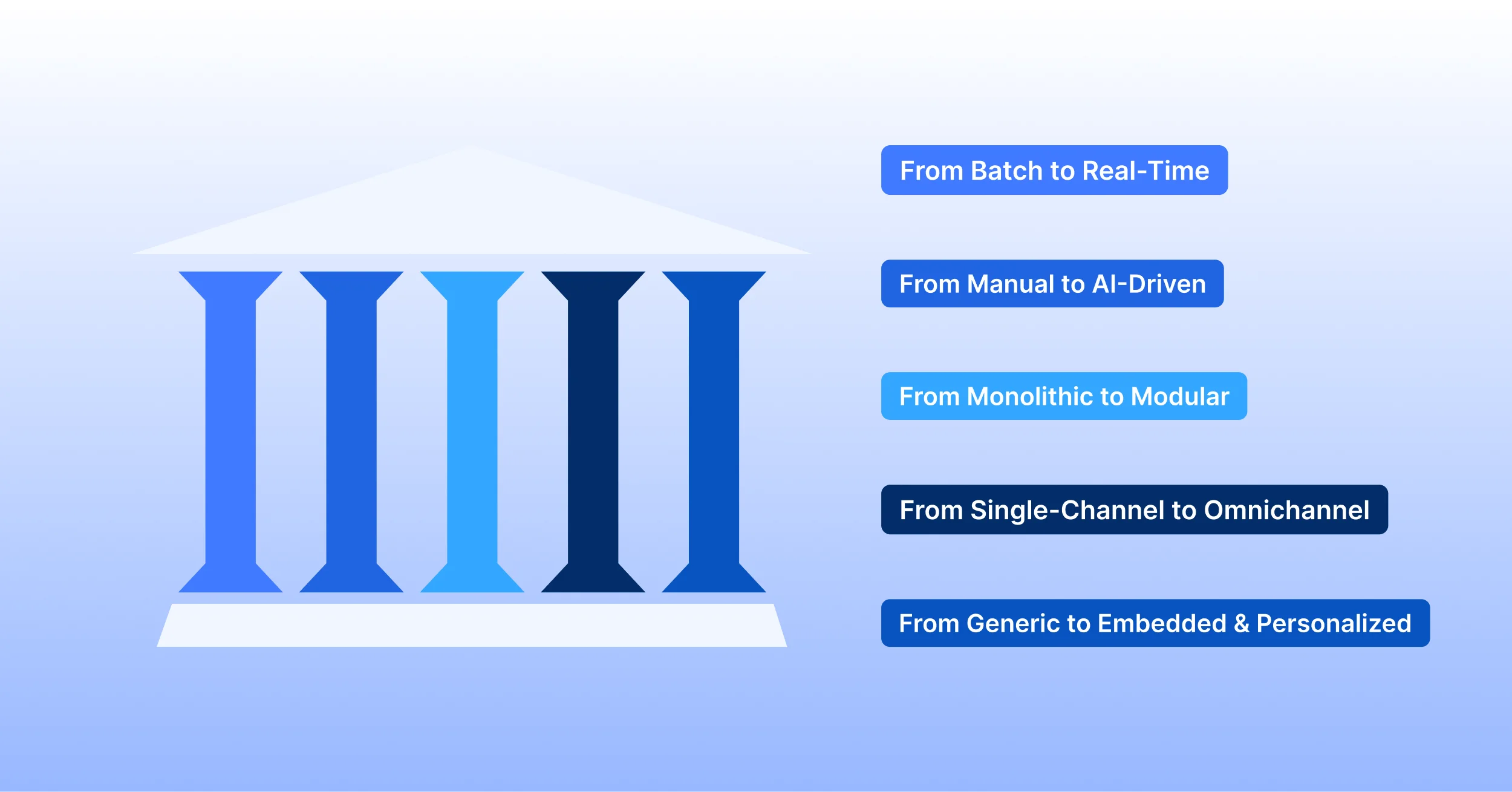
Digital transformation impacts every stage of the payment lifecycle. These five pillars highlight the technologies reshaping modern payment processing and explain why businesses are moving away from legacy payment systems.
Pillar 1 – From Batch to Real-Time
Legacy: Settlement in 3 to 5 days; batch processing runs overnight.
Now: Real-time payment rails (FedNow, UPI, SEPA Instant) and instant settlement options available directly to merchants.
Impact: A genuine cash-flow transformation for small and mid-sized businesses (SMBs) – funds move at the speed of the transaction.
Pillar 2 – From Manual to AI-Driven
Legacy: Rule-based fraud detection, manual reconciliation, human review queues.
Now: Machine-learning fraud engines (Stripe Radar, Adyen RevenueProtect) and automated reconciliation running continuously in the background.
Impact: Materially higher fraud-catch rates alongside noticeably fewer false declines, which means fewer legitimate customers get wrongly blocked at checkout.
Pillar 3 – From Monolithic to Modular (APIs & Open Banking)
Legacy: A single, one-size-fits-all payment processor locked into your business.
Now: API-first architecture, open banking, and payment orchestration layers.
Impact: Businesses can mix and match payment gateways to optimize for cost, coverage, or speed instead of accepting whatever bundle a single vendor offers.
Pillar 4 – From Single-Channel to Omnichannel
Legacy: Online only or point of sale (POS) only payment setups that don’t talk to each other.
Now: Unified commerce spanning online, mobile, in-store, social, and invoice-based payments.
Impact: A consistent customer experience and a single view of transaction data, regardless of where the sale happened.
Pillar 5 – From Generic to Embedded & Personalized
Legacy: A standard, one-size-fits-all checkout page bolted onto the end of the buying journey.
Now: Embedded finance, payments built directly into any app or workflow, plus personalized, one-click checkout.
Impact: Checkout has become a product feature in its own right, not an afterthought tacked on at the end.
What Are the Benefits of Digital Transformation?
Businesses investing in digital payment transformation don’t simply replace outdated systems – they improve operational efficiency, enhance customer experiences, strengthen security, and position themselves for long-term growth.
Key benefits of digital transformation include:
- Increased Efficiency
- Streamlines workflows and business processes.
- Speeds up transactions and service delivery.
- Eliminates manual and paper-based operations.
- Reduced Costs
- Automates repetitive tasks to reduce labor costs.
- Minimizes operational expenses.
- Improves resource utilization and productivity.
- Improved Customer Satisfaction
- Delivers faster, smoother payment experiences.
- Enhances convenience and reliability.
- Encourages customer loyalty and repeat business.
How Is Digital Transformation Affecting the Payment Industry?
Digital transformation is changing the payment industry by making transactions faster, more secure, and more convenient for both businesses and customers. Modern technologies such as cloud-based payment platforms, AI-powered fraud detection, APIs, and real-time payment networks are replacing legacy systems and improving every stage of the payment process.
As customer expectations continue to evolve, businesses are adopting digital payment solutions that support multiple payment methods, automate operations, strengthen security, and deliver seamless checkout experiences. These innovations not only improve operational efficiency but also help businesses stay competitive in an increasingly digital economy.
What Trends Are Emerging in the Payment Industry as a Result of Digital Transformation?

Digital transformation is driving new payment trends that make transactions faster, more secure, and more convenient for both businesses and consumers.
- Growth of Digital Payments – Consumers are increasingly choosing digital payment methods for everyday transactions.
- Rise of Mobile Wallets – Mobile wallets offer a secure, convenient way to make payments.
- Expansion of Contactless Payments – Tap-to-pay solutions are becoming a standard payment option.
- Real-Time Payments – Instant payment processing and faster settlements are gaining widespread adoption.
- AI-Powered Fraud Prevention – AI helps detect suspicious activity and reduce payment fraud.
- Omnichannel Payment Experiences – Businesses are delivering seamless payment experiences across online and offline channels.
How Digital Transformation Is Leveraging the Payment Industry – 6 Tangible Impacts
Digital transformation is reshaping the payment industry by introducing faster, smarter, and more secure ways to process transactions. Digital technologies are driving innovation across the payments ecosystem. Below are six tangible impacts of digital transformation on the payment industry.
1. Transaction Costs Are Falling
Legacy processing often carries an effective rate of 3–5% once hidden fees are factored in. Digitally transformed processing uses Interchange++ pricing and real-time routing to the cheapest available acquirer.
Example: A WooCommerce store using WP Easy Pay with Square pays 2.6% + 10¢ per transaction, compared to an industry average of closer to 3.5%.
Digital transformation makes payment processing a competitive advantage.
2. Settlement Speed Is Accelerating
Legacy processors often held funds for 3-7 business days before they became available. Transformed systems offer next-day settlement (Stripe) or instant settlement (Square), with real-time rails like FedNow pushing the frontier further.
The cash flow math: for a business processing $50,000/month, shaving even four days off the settlement cycle can free up more than $6,700 in working capital over a year. For WordPress businesses, plugins such as WP Easy Pay enable merchants to leverage modern payment infrastructure.
3. Fraud Detection Has Gone From Reactive to Predictive
Legacy fraud management largely meant dealing with chargebacks after the damage was already done. Now, real-time AI scoring flags risks before a transaction ever completes, using models trained on transaction data at a scale that no individual merchant could replicate alone.
For WordPress site owners, this matters because WP Easy Pay inherits Square’s enterprise-grade machine-learning fraud scanning automatically – there’s no extra tool to buy and no extra cost to unlock it.
4. Checkout Conversion Has Improved by 20–40%
Average cart abandonment rates hover around 70%, but optimized checkouts can bring that down to 40-50%, with best-in-class performers achieving rates closer to 20-25%. The drivers are consistent: one-click purchasing, digital wallets, local payment methods, and raw speed. The underlying UX shift is dramatic — from 12-field checkout forms to two-click experiences.
WP Easy Pay supports customizable checkout forms, Apple Pay, and Google Pay, and it’s set up without touching a line of code.
5. Cross-Border Payments Have Democratized
Legacy international payments required specialized merchant accounts and cash reserves held in each local currency. Modern gateways are built to support multi-currency acceptance across 135+ currencies, and FX spreads have compressed from the 3-4% typical of bank rates to roughly 0.5-1% with modern processors.
Example: A WP Easy Pay user based in Canada, selling to customers in the US, the UK, and Australia, can process all of it through a single plugin.
6. Compliance Has Automated
Legacy compliance meant manual PCI audits and navigating licensing requirements country by country. Modern platforms build PCI DSS Level 1 compliance directly into the product (Stripe, Square, Adyen), and Merchant of Record models are automating VAT/GST handling for cross-border tax compliance.
For SMBs, the win is simple: WP Easy Pay users processing payments through Square can qualify for the simplest PCI compliance form (SAQ A), significantly reducing their compliance burden compared to handling card data directly
What Challenges Does Digital Transformation Present for the Payment Industry?
The answer is that it presents many challenges. For one thing, the way people pay for things is changing. They’re using their phones and other devices to make payments, which is putting a lot of pressure on the payment industry to keep up with the latest technologies.
Another challenge is that as more businesses go digital, consumer payment preferences are diversifying beyond traditional card-present transactions to include digital wallets, buy-now-pay-later, and real-time payment methods, requiring payment providers to support an expanding array of options. This is causing significant disruption in the payment industry as companies scramble to find new ways to make money.
It’s a challenging time for the payment industry, but I do not doubt it will find a way to adapt and thrive in the digital age.
Embracing Digital Transformation in Payments
Digital transformation is redefining how businesses accept, process, and manage payments. Modern payment technologies enable organizations to automate payment processing, strengthen security, reduce operational costs, and deliver faster, more convenient checkout experiences across online and in-person channels.
As customer expectations continue to evolve, adopting modern payment solutions is no longer optional for businesses that want to remain competitive. Whether you’re running a small business or managing a growing ecommerce store, investing in the right payment technology can improve operational efficiency and support long-term growth.
If you use WordPress, WP Easy Pay makes it easy to modernize your payment experience. With secure Square integration, support for popular payment methods, and no-code setup, you can start accepting payments quickly without building a custom payment infrastructure.
Frequently Asked Questions
What is digital transformation in the payment industry?
Digital transformation in the payment industry involves adopting modern technologies to make payment processing faster, more secure, and more efficient through automation, cloud solutions, APIs, and AI.
How does AI impact payment processing?
AI improves payment processing by detecting fraud in real time, reducing false declines, automating routine tasks, and delivering more personalized payment experiences.
What is the biggest change digital transformation has brought to payments?
The biggest change is faster, more accessible, and more secure payment processing, enabling businesses of all sizes to use advanced payment technologies.
Do small businesses need digital transformation for payments?
Yes. Digital payment solutions help small businesses reduce costs, improve checkout experiences, and receive payments more quickly.
How can I digitally transform my payment processing without a developer?
You can use a no-code payment solution or plugin, such as WP Easy Pay, to integrate modern payment processing into your WordPress or WooCommerce site without custom development.
Is WP Easy Pay compatible with my existing payment gateway?
WP Easy Pay is designed to integrate with Square. If you’re switching from another gateway, review the plugin’s documentation to ensure compatibility with your current setup.